Direct selling and network marketing have always been built on relationships: trust between distributors, transparency in commissions, and quick, reliable payments. Yet traditional MLM Software often struggles with opaque ledgers, delayed payouts, fraud, and disputes over commission calculations. Enter blockchain-based MLM software — a technological leap that promises to fix many industry pain points. The global direct selling and network marketing industry is undergoing a major digital transformation. As competition increases and regulatory scrutiny tightens, businesses can no longer rely on outdated systems that lack transparency, security, and scalability. Modern distributors expect real-time earnings visibility, faster payouts, and absolute fairness in commission distribution. This is where blockchain-powered MLM software is redefining the future of direct selling.
Traditional MLM Software platforms operate on centralised databases, making them vulnerable to data manipulation, delayed payments, and trust issues among distributors. In contrast, blockchain-based MLM software introduces decentralisation, immutability, and automation into network marketing operations. By recording transactions on a secure distributed ledger and executing commission rules through smart contracts, blockchain technology ensures accuracy, transparency, and efficiency at every level.
Forward-thinking businesses are now partnering with advanced MLM Software Company providers like SWA MLM to gain a competitive edge. By combining proven compensation plan logic with next-generation blockchain architecture, these platforms enable brands to scale globally while maintaining compliance, distributor confidence, and operational excellence.
Why traditional MLM software is ripe for innovation
Traditional MLM Software has served the industry for decades: tracking sponsorship trees, computing commissions, and managing members. Yet common shortcomings persist:
- Centralised control: Data sits with the company; distributors must trust the operator for accuracy.
- Manual reconciliation: Disputes over commissions or sales often need manual investigation.
- Delayed payouts: Cross-border transfers and banking processes slow down distributor earnings.
- Security risks: Centralised databases can be hacked or altered.
- Lack of verifiable transparency: Distributors can’t independently verify sales, volume, or payout history.
These weaknesses create friction for recruitment and retention in Direct Selling MLM Software businesses. Blockchain addresses many of these problems at a protocol level — not by replacing business logic, but by creating a trustworthy, auditable foundation.
What is blockchain-based MLM software?
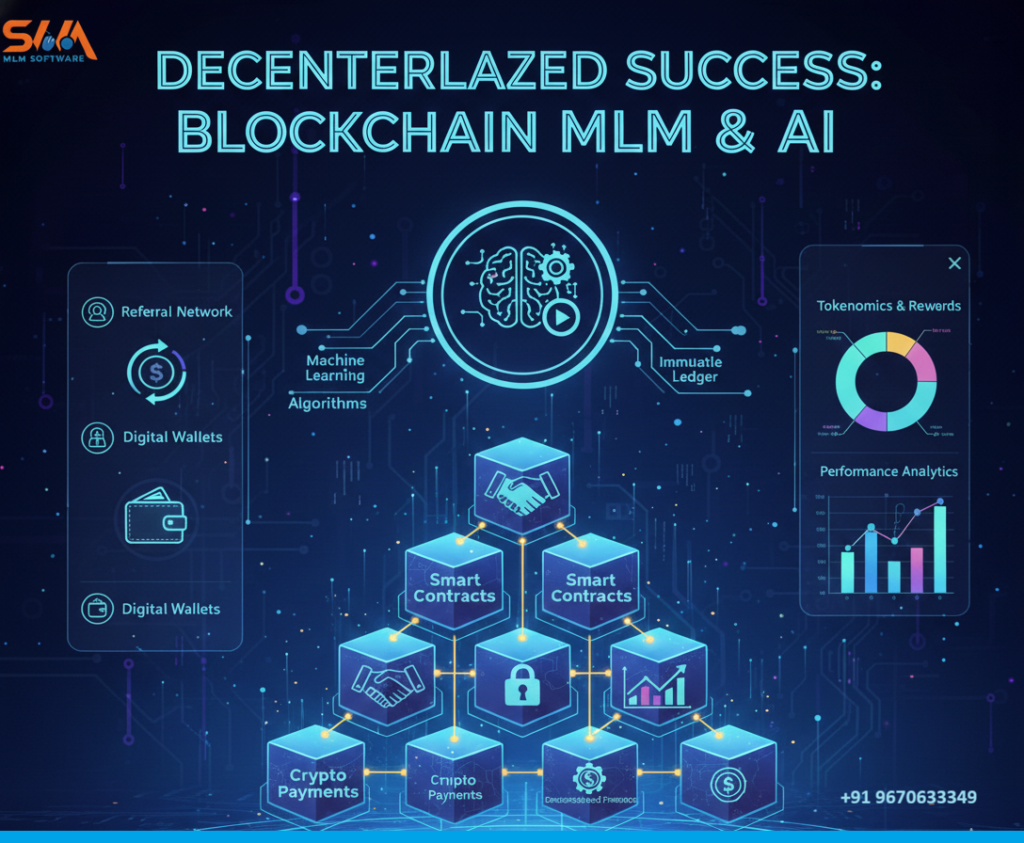
Blockchain-based MLM software integrates distributed ledger technology into core MLM functions. Instead of a single database controlled by the company, a blockchain (public or permissioned) records transactions — sales, commissions, rank changes, and rewards — in an immutable ledger. Smart contracts automate business rules, ensuring commissions are calculated and distributed according to encoded logic without human intervention.
Key components of blockchain MLM systems:
- Distributed ledger: A tamper-resistant record of transactions.
- Smart contracts: Self-executing code that enforces commission rules, bonuses, and rank qualifications.
- Cryptographic identities: Secure accounts for distributors that reduce impersonation or fraud.
- Tokenisation (optional): Native tokens or stablecoins can be used for micro-payments, incentives, or reward systems.
- APIs & integrations: Connect on-chain records with off-chain systems (e.g., CRMs, KYC providers, e-commerce platforms).
This architecture doesn’t remove the need for a strong MLM Software Company or business strategy; it simply provides a more trustworthy, efficient, and auditable platform for Network Marketing MLM Software.
Benefits for companies and distributors
- Absolute transparency and auditability
Every sale, commission, and change logged on-chain is immutable and timestamped. Distributors can verify their earnings independently, reducing disputes and boosting trust. For Direct Selling MLM Software, transparency improves recruiter confidence and fosters long-term loyalty.
- Automated and instant payouts
Smart contracts can trigger immediate payouts to distributor wallets once conditions are met. This reduces dependence on bank settlement cycles and can dramatically improve cash flow for distributors, especially those in regions with slow banking infrastructure.
- Fraud reduction and better compliance
Immutable records and cryptographic identities make it harder to manipulate volumes or create fake accounts. Permissioned blockchains combined with identity verification (KYC/AML) help firms comply with regulations without sacrificing decentralised integrity.
- Lower reconciliation costs
Automation reduces manual reconciliation work. Auditors can reconcile data using the ledger itself, and fewer human interventions mean lower operational costs for an MLM Software Company.
- New incentive models
Tokenisation enables innovative reward structures: loyalty tokens, vesting schedules, and gamified leaderboards. Tokens can be exchangeable for services, products, or even converted to fiat (subject to local law), creating flexible incentive ecosystems within Network Marketing MLM Software.
- Global reach and micropayments
Blockchain simplifies international microtransactions. Companies can pay distributors worldwide with reduced fees and near-instant settlement, an enormous advantage for global Direct Selling MLM Software businesses.
Core features of blockchain-powered MLM software
If you’re evaluating MLM Software or seeking a vendor, a blockchain-capable platform should include:
Immutable transaction ledger
An auditable record of every sale, refund, commission, and rank change.
Smart contract engine
Configurable templates for commission plans (binary, unilevel, matrix, hybrid), auto-qualifications, and bonuses.
Wallet management
Secure wallets for distributors, with multi-currency support (fiat gateways plus crypto wallets).
KYC/AML integration
Onboarding flows linking identity verification to on-chain accounts to meet regulatory requirements.
API layer & middleware
Bridges between the blockchain and legacy systems (ERP, payment processors, e-commerce platforms).
Admin dashboards & analytics
Real-time dashboards for businesses and private dashboards for distributors showing on-chain provenance of claims.
Role-based permissions
Granular access control to manage who can see or modify off-chain data — essential for privacy and compliance.
UX-focused mobile apps
User-friendly mobile experiences for distributors who often operate with smartphones as their primary device.
Why SWA MLM is highlighted — a modern approach
SWA MLM (mentioned at the start) exemplifies the kind of vendor reimagining MLM platforms for the blockchain era. While many legacy MLM Software Company offerings patch decentralised features over old systems, solutions like SWA MLM are built with blockchain-first thinking — meaning:
- Commission logic is modelled as smart contracts to eliminate human error.
- Distributor wallets are integrated natively into the platform to enable near-instant payouts.
- Token-based incentives are available as optional modules for businesses that want gamification or loyalty programs.
- The platform focuses on user experience, ensuring blockchain complexity is hidden from the distributor — a must for adoption.
If you’re evaluating Network Marketing MLM Software, look for vendors that combine business-domain expertise with blockchain engineering — that’s where SWA MLM and similar platforms shine.
Where blockchain MLM creates the most value
- Cross-border direct selling businesses
Companies with distributors in multiple countries benefit from faster, cheaper payouts and a unified, transparent ledger.
- High-volume referral networks
When thousands of daily transactions create heavy reconciliation workloads, a blockchain ledger reduces disputes and streamlines auditing.
- High-churn markets
Transparency reduces distrust among new distributors, improving retention in markets where pyramid-skepticism is high.
- Tokenised loyalty ecosystems
Brands wanting to create internal economies (rewards for training completion, events, referrals) can issue tokens to drive engagement.
- Regulated environments
In regions where regulators demand stringent audit trails, permissioned blockchains combined with KYC can simplify compliance.
Technical considerations: public vs permissioned blockchains
Choosing the right ledger architecture is crucial:
Public blockchains
- Pros: Maximum decentralisation and verifiability; broad developer tooling.
- Cons: Transaction fees (gas) can be volatile; public visibility of transactions may be a privacy concern; scaling limitations unless layer-2 solutions are used.
Permissioned/Private blockchains
- Pros: Controlled participation, better privacy, predictable costs, and enterprise-friendly governance.
- Cons: Less decentralised — trust is placed in consortium members — and fewer public audit options.
Many MLM Software Company products choose a hybrid approach: on-chain proofs for critical events (e.g., hash of off-chain data stored on a public chain) while keeping sensitive records in a permissioned ledger or secure off-chain store. SWA MLM-type solutions often adopt hybrid models to balance transparency, cost, and privacy.
Implementing blockchain into your MLM operation
Adopting blockchain-based MLM software isn’t a simple plug-and-play exercise. Here’s a practical implementation roadmap for a Direct Selling company:
- Business case & stakeholder alignment
Identify clarity drivers: dispute reduction, faster payouts, global expansion, or loyalty tokenisation. Get buy-in from legal, finance, operations, and marketing.
- Choose the right vendor and architecture
Evaluate MLM Software Company options focusing on blockchain experience, compliance support, UX design, and proven integrations. Consider whether you need public, permissioned, or hybrid chains.
- Define commission logic & smart contract specs
Map existing compensation plans to smart contracts. This requires careful specification so the contract reflects the business rules exactly.
- KYC/AML & identity integration
Link distributor onboarding to KYC providers. Decide how identity data maps to on-chain pseudonymous accounts while respecting privacy laws (e.g., GDPR).
- Wallet & payment flows
Decide which currencies to support, fiat on/off ramps, and whether to hold funds in company-managed custody or let distributors manage their own wallets.
- Pilot & phased rollout
Start with a controlled pilot (a region or product line) to validate operations, payouts, and analytics before a global switch.
- Training & communications
Educate distributors about the platform’s benefits and how to use wallets, dashboards, and token systems. Clear communication is vital to avoid fear and confusion around the “blockchain” term.
- Compliance & audits
Implement ongoing audits, regulatory reporting, and legal review. Engage auditors to verify smart contracts and reconciliations.
Security, disputes, and governance
Even though blockchain brings immutability, you still must handle real-world complexities:
- Smart contract bugs: Contracts should be audited by reputable security firms. Have upgrade patterns (proxy contracts) and emergency kill-switches controlled by multisig governance.
- Dispute resolution: On-chain records help, but off-chain evidence (photos, delivery confirmations) will still be necessary. Design hybrid workflows for arbitration.
- Data privacy: Use off-chain storage for personal data; on-chain store cryptographic proofs or hashes to preserve auditability without exposing personal information.
- Governance: Define who controls upgrades, who can propose changes, and how distributor voting works if you implement token governance.
Good MLM Software Company vendors include governance frameworks and recommended best practices to reduce operational risk.
Regulatory landscape and compliance
Regulatory considerations for blockchain-based MLM software vary by country:
- Financial regulation: Tokenisation may trigger securities, e-money, or money-transmission laws. Always consult legal counsel before launching token rewards.
- Consumer protection: Transparent, immutable ledgers can satisfy many consumer-protection requirements, but companies must still provide terms, refund policies, and dispute mechanisms.
- KYC/AML: Global direct selling platforms must integrate robust KYC for onboarding and AML monitoring for suspicious flows—particularly if tokens can be converted to fiat.
- Data privacy: Laws like GDPR (EU) or local privacy acts influence how personal data is stored and linked to on-chain identifiers.
Choose an MLM Software Company that provides compliance modules or guidance. SWA MLM-style vendors often support KYC integrations and structured compliance workflows as standard.
Advantages of blockchain MLM
Adopting blockchain gives marketing teams strong positioning:
- Trust messaging: “Transparent payouts,” “immutable commission record,” and “instant payouts” are compelling hooks in recruitment drives.
- Product differentiation: Use blockchain as a differentiator against competitors still using opaque systems.
- Content marketing: Whitepapers, case studies, and explainer videos about how distributed ledger technology benefits distributors can greatly enhance conversion rates.
Remember: technology alone won’t win the market. The sales story must emphasise how the blockchain benefits individual earners — faster cash, fewer disputes, and demonstrable fairness.
Cost considerations and ROI
Blockchain features introduce new cost lines — development, smart contract audits, wallet management, and possibly transaction fees. However, savings and ROI come from:
- Reduced reconciliation and fraud investigation costs.
- Lower chargebacks and refund management overhead.
- Improved distributor retention and faster onboarding conversions.
- Reduced cross-border payment fees when using crypto rails or efficient payment partners.
An MLM Software Company should provide a clear TCO (total cost of ownership) comparison showing break-even points based on reduced disputes and operational overhead.
Conclusion — a practical, trust-first future
Blockchain-powered MLM software represents a major leap in how direct selling platforms handle transparency, payments, and trust. It doesn’t magically fix business model flaws, but it changes the infrastructure: immutable records, automated payouts, and token-enabled incentives open new possibilities for growth and distributor satisfaction.
For companies shopping for MLM Software, demand platforms that combine domain expertise with mature blockchain engineering — platforms like SWA MLM that treat blockchain as an enabler rather than a gimmick. Prioritise vendors that hide blockchain complexity, integrate compliance, and demonstrate measurable operational improvements. By embracing blockchain-based MLM software, forward-looking direct selling businesses can reduce disputes, accelerate payouts, and offer transparent, compelling value to their distributors — building the next generation of resilient, ethical, and scalable Direct Selling MLM Software and Network Marketing MLM Software.
FAQs
Q: Is blockchain necessary for every MLM business?
A: No. Smaller businesses with simple compensation plans may not need blockchain immediately. However, if your business is cross-border, experiences reconciliation friction, or needs audit-grade transparency, blockchain can deliver outsized value.
Q: Will distributors need to understand cryptocurrency?
A: Not necessarily. Platforms can abstract wallets and convert tokens to fiat. Cryptocurrency knowledge is optional when implemented with user-friendly flows.
Q: Are smart contracts reversible?
A: Smart contracts are immutable by design. However, responsible design uses upgradeable patterns and multi-signature admin controls to correct emergencies while preserving audit trails.
Q: How long does implementation take?
A: Timelines vary: a pilot might take 3–6 months; full migration could take 6–18 months, depending on scale. Work in phases to reduce risks.
Q: Does blockchain remove the need for audits?
A: No. Blockchain provides auditability, but independent audits (smart contract audits, financial audits) remain critical.