Running a successful direct selling business today is about more than charismatic leaders, great products, and motivated distributors. It’s about systems — automated, transparent, and scalable systems that keep commissions accurate, compliance intact, and growth repeatable. That’s where the right MLM Software comes in. Choosing the best technology for your network marketing operation separates companies that plateau from those that scale rapidly and sustainably. To meet these expectations and stay competitive, every modern direct selling company needs a powerful and reliable MLM Software system.
Direct selling has evolved dramatically. Where business once relied predominantly on face-to-face contact and paper ledgers, today’s network marketing companies must deftly manage online enrollments, complex compensation plans, international tax rules, fast payments, and real-time analytics. The scale and speed of modern direct selling mean operational complexity grows exponentially — and without proper automation, that complexity becomes risk. As networks expand, managing distributor hierarchies, complex compensation plans, sales volumes, and compliance requirements becomes increasingly challenging. Without automation, even a small error in commission calculation or payout can lead to disputes, loss of trust, and damage to the brand’s reputation. This is where MLM Software for Direct Selling plays a critical role—bringing accuracy, transparency, and efficiency to every aspect of the business.
The problem with manual and ad-hoc processes
Many direct selling companies begin with spreadsheets, basic bookkeeping systems, or off-the-shelf e-commerce tools that are stitched together. This “duct tape” approach creates problems that compound as the company grows:
- Human error in commission calculations and enrolments. Manual spreadsheets don’t scale and are fragile.
- Delayed payouts and disputes that damage distributor trust.
- Poor visibility: no single source of truth for sales, rank advancement, or inventory.
- Operational bottlenecks: finance and admin teams become gatekeepers, slowing growth.
- Compliance risks: difficulty demonstrating full audit trails or adhering to region-specific rules.
- Inconsistent onboarding: new distributors receive different experiences depending on the region or sponsor.
In short, manual systems cost more than the upfront price of a professional MLM Software — they cost growth, trust, and time.
Why MLM Software is no longer optional
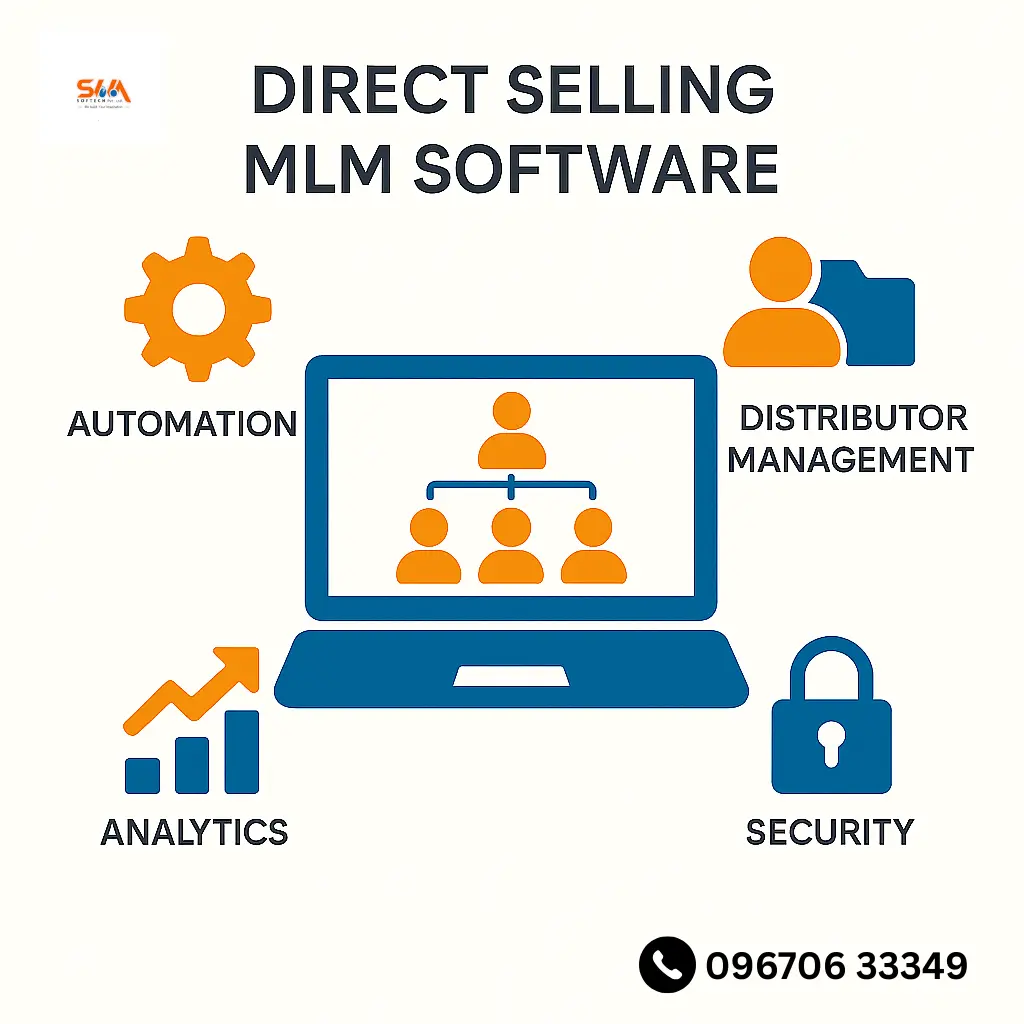
Modern MLM Software for Direct Selling does far more than calculate commissions. It automates processes across the distributor lifecycle: recruitment, onboarding, sales processing, commission calculation, performance tracking, payouts, and compliance. The improvements are tangible:
- Accuracy and fairness — automated compensation engines remove ambiguity.
- Speed — real-time calculation and instant dashboards accelerate decisions.
- Scalability — support thousands or millions of distributors without linear increases in administration.
- Insights — reporting and analytics reveal what’s working (and what’s not).
- Compliance — built-in controls and audit logs reduce legal risk.
- User experience — mobile apps and self-service portals increase engagement and retention.
These capabilities directly translate into higher distributor satisfaction, lower churn, and faster growth — investing in the Best MLM Software is a strategic necessity for any ambitious direct selling brand.
Core features every MLM Software for Direct Selling must have
Not all MLM platforms are created equal. When evaluating any MLM Software Company or product, prioritize the following core feature set:
- a) Flexible compensation engine
Support for multiple plan types (binary, matrix, unilevel, hybrid, board-plan, etc.), custom rules, overrides, and bonus structures. The engine should be configurable without code changes and able to simulate scenarios.
- b) Real-time payout calculations
Accurate, auditable calculations that update in real time and drive timely commissions and bonuses.
- c) Distributor self-service portal & mobile app
Enrollments, downline views, commission statements, training content — all accessible via web and mobile to keep teams engaged.
- d) E-commerce and inventory management
Product catalog, order processing, returns, shipping, and stock management are integrated with the compensation logic.
- e) KYC / compliance management
Identity verification, region-specific tax forms, and automated compliance checks to reduce legal exposure.
- f) Reporting & analytics
Custom dashboards, sales trends, top performers, churn analysis, and real-time KPIs for leadership and field leaders.
- g) Multi-currency, multi-language, multi-entity support
Essential for companies operating across regions — handling local taxes, currency conversion, and localized user experiences.
- h) Secure payment and payout integrations
Multiple payment gateways, automated payouts (bank, e-wallets), and reconciliation tools.
- i) Role-based access control & audit logging
Ensure proper controls and full visibility into changes and system actions.
- j) API & extensibility
Seamless integrations with CRMs, marketing automation, ERP, tax services, or custom apps—so your technology can grow with your business.
When a platform ticks all these boxes, it’s more than software — it’s an operational backbone.
How the right MLM platform improves distributor experience and retention
A distributor-friendly platform leads to better retention — and retention is one of the most critical drivers of long-term value.
Faster onboarding
Automated enrollment workflows, ID verification, and instant kit shipments let recruits start selling quickly.
Transparent earnings
Self-service commission statements and rank tracking remove confusion and build trust.
Learning and community
Built-in training portals, video libraries, and community features help distributors learn and replicate successful strategies.
Mobile-first convenience
Field salespeople want quick access to sign-ups, order placement, and commission status — a poor mobile experience loses sales.
When distributors can see their progress and earnings instantly, they’re more likely to stay active and invest in growth.
Choosing the right MLM Software Company: criteria & process
Selecting an MLM Software Company requires a structured process. Here’s a practical checklist and evaluation approach.
Step 1 — Define business requirements
Map your compensation plan, product flow, regulatory needs, reporting expectations, and scalability targets. Document must-have vs nice-to-have features.
Step 2 — Vendor shortlisting
Look for vendors with domain expertise in direct selling. Check client portfolios, case studies, and industry reputation.
Step 3 — Product demos & scenario testing
Insist on live demos using your data and compensation scenarios. Ask vendors to model a few actual payout instances — not generic demos.
Step 4 — Tech fit & integration
Evaluate the vendor’s API, data export capabilities, and ability to integrate with your existing e-commerce, accounting, and CRM tools.
Step 5 — Security & compliance
Assess data encryption, hosting (cloud vs on-premise), GDPR, and local data residency support, and audit capabilities.
Step 6 — SLA, support, and roadmap
Review service level agreements, uptime guarantees, support response times, and the vendor’s product roadmap — especially for features you’ll need in 12–24 months.
Step 7 — Pricing transparency
Understand licensing, implementation, hosting, customization, and ongoing support costs. Beware of opaque pricing that hides essential fees.
Step 8 — Pilot & phased rollout
Start with a pilot region or business unit before full-scale deployment. This reduces risk and surfaces real-world integration issues.
Using this process will help you objectively evaluate vendors and select the Best MLM Software for your needs.
Swa MLM — what it offers and why it’s relevant
Among the many MLM Software Companies available, Swa MLM stands out for a few reasons that matter to modern direct selling companies:
Deep domain focus
Swa MLM is built specifically for network marketing and direct selling businesses. That means core features—compensation engines, distributor portals, and compliance modules—are purpose-built rather than retrofitted.
Flexible compensation and plan support
Swa MLM supports multiple compensation models out of the box and allows for custom rules and simulations, making it suitable for companies experimenting with hybrid or evolving plans.
End-to-end commerce integration
From product catalog to order fulfillment and returns, Swa MLM integrates the e-commerce flow with payouts so that order exceptions don’t lead to commission errors.
Localisation & compliance tools
For companies expanding into new markets, Swa MLM provides multi-currency and multi-language capabilities and has built-in support for common KYC and tax-related requirements.
Analytics and reporting
Swa MLM includes dashboards tailored for leadership and field sales, enabling better planning, campaign tracking, and distributor coaching.
Implementation and support
One of the most frequent reasons companies choose Swa MLM is their combination of platform features with implementation support — helping companies map complex compensation logic into production quickly and reliably.
Measuring ROI: How to justify the investment in Best MLM Software
Decision-makers want clear ROI. Here are the most tangible value levers and how to measure them:
- Reduced payout errors and disputes
- Metric: Number of payout disputes per month.
- Value: Each dispute consumes finance and support hours and risks distributor churn.
- Faster onboarding and higher conversion
- Metric: Time from lead to first order; conversion rate of sign-up to active seller.
- Value: Faster activation increases lifetime value per distributor.
- Increased retention and active ratio
- Metric: Active distributors as a percentage of total.
- Value: Small improvements in retention compound substantially over time.
- Productivity gains in the back office
- Metric: Hours/month saved in commission calculations, reconciliations, and reporting.
- Value: Staff cost savings or redeploying teams to growth initiatives.
- Faster payouts & liquidity management
- Metric: Time from sale to payout processing.
- Value: Satisfied distributors and fewer support inquiries.
- Incremental sales driven by better analytics
- Metric: Uplift in average order value or frequency.
- Value: Targeted campaigns based on analytics drive measurable top-line growth.
When you quantify these gains — in reduced costs, increased revenue, and lower churn — the payback period on high-quality MLM Software is often shorter than expected.
Security, compliance, and audit trails — non-negotiables
Direct selling businesses often handle sensitive personal and financial information across borders. Choosing an MLM Software Company with a robust security posture is essential:
- Data encryption at rest and in transit.
- Role-based access and multi-factor authentication.
- Detailed audit logs for distributor actions, payout changes, and admin overrides.
- Data residency and GDPR / local law compliance, where applicable.
- Secure payment integrations and PCI-compliant payment processing.
- Disaster recovery and backups with clear RTOs and RPOs.
Vendors must be able to provide security certifications and a detailed data processing addendum (DPA). For regulated markets, legal teams should review data flows and retention policies before deployment.
Common pitfalls and how to avoid them
Even with the best intentions, implementations can fail. Here’s what often goes wrong — and how to prevent it.
Pitfall 1: Choosing on price alone
Solution: Prioritize total cost of ownership (including hidden customization and integration costs) and business impact.
Pitfall 2: Underestimating custom requirements
Solution: Define critical workflows early and validate them in demos. Avoid platforms that require extensive bespoke development.
Pitfall 3: Ignoring field feedback
Solution: Involve top-performing distributors in pilot testing and training design.
Pitfall 4: Poor data migration
Solution: Run multiple dry runs, reconcile historical payouts, and test edge cases like returns and overrides.
Pitfall 5: No clear exception handling
Solution: Design clear business processes for reversals, cancellations, and disputes, and build them into the platform.
Avoiding these traps increases the chance of a smooth, successful rollout.
Future Trends in MLM Software
Technology keeps evolving — and the Best MLM Software adapts. Expect the following trends to shape direct selling in the near term:
- AI-driven analytics and coaching: predictive churn models, lead scoring, and personalized coaching recommendations for field leaders.
- Micro-payments and digital wallets: faster, lower-cost payouts, particularly in emerging markets.
- Gamification and engagement layers: leaderboards, achievement badges, and micro-incentives integrated into the mobile app.
- Blockchain for transparency: immutable audit trails for commission histories and product provenance in select deployments.
- Headless commerce and omnichannel selling: seamless experiences across social shops, marketplaces, and direct channels.
- Embedded compliance automation: auto-generated tax documentation and region-aware product controls.
Choosing a vendor with a modern architecture and an innovation roadmap (like many top MLM Software Companies) will help future-proof your business.
Quick checklist: Is your business ready for MLM software?
- Do you have recurring payout errors or disputes? ✅
- Are onboarding and activation times slow? ✅
- Do you lack a single source of truth for sales and downlines? ✅
- Do you operate in multiple currencies or countries? ✅
- Is your back office overwhelmed by manual reconciliation? ✅
Conclusion
Direct selling is a relationship-driven business — but relationships thrive on trust and clarity. The right MLM Software Company gives you the tools to scale those relationships while protecting margins and ensuring compliance. Whether you choose a well-known provider or evaluate a specialist like Swa MLM, invest time in a careful selection and pilot process. The outcome is worth it: predictable growth, happier distributors, and a more agile, data-driven business. In today’s fast-paced and highly competitive direct selling industry, choosing the right MLM Software is no longer a luxury—it is a necessity. As networks grow, compensation plans become more complex, and compliance requirements tighten, manual systems and basic tools simply cannot keep up. The right MLM Software for Direct Selling brings structure, transparency, and scalability to your business, allowing you to focus on growth rather than operational challenges.
A reliable and experienced MLM Software Company helps automate commissions, streamline distributor onboarding, ensure accurate payouts, and deliver real-time insights that drive smarter decisions. More importantly, it builds trust among distributors by offering clear earnings visibility, timely payments, and a professional digital experience. These factors directly impact retention, motivation, and long-term success. Platforms like Swa MLM demonstrate how modern solutions can support flexible compensation plans, global operations, and compliance needs while remaining user-friendly for both administrators and distributors. By investing in the Best MLM Software, you create a strong technological foundation that supports sustainable expansion, reduces errors, and enhances distributor satisfaction.
Frequently Asked Questions (FAQ)
- What is MLM software?
MLM Software is a specialized digital platform designed to manage and automate all operational aspects of a network marketing or direct selling business. It handles distributor registration, downline management, commission calculations, payouts, product sales, reporting, and compliance—helping businesses scale efficiently and accurately.
- Why is MLM software important for a direct selling business?
Direct selling businesses deal with complex compensation structures and large distributor networks. MLM Software for Direct Selling eliminates manual errors, ensures timely and accurate commissions, improves transparency, and enhances distributor trust—making it essential for sustainable growth.
- How does MLM software help in commission calculation?
MLM software uses automated compensation engines to calculate commissions based on predefined rules and plans such as binary, unilevel, matrix, or hybrid models. This ensures accuracy, fairness, and real-time updates, reducing disputes and administrative workload.
- What features should I look for in the best MLM software?
The Best MLM Software should include:
- Flexible compensation plan management
- Distributor dashboards and mobile access
- Real-time commission tracking
- E-commerce and inventory integration
- Reporting and analytics
- Security, compliance, and audit logs
- Multi-currency and multi-language support
- How do I choose the right MLM software company?
When selecting an MLM Software Company, evaluate their industry experience, client portfolio, software scalability, security standards, customization options, implementation support, and post-launch customer service. Live demos and pilot testing are highly recommended.